How Bill Is Supporting Amyloidosis Patients for Decades to Come
Johnny Rosa
Marketing & Communications Manager
Amyloidosis Research Consortium
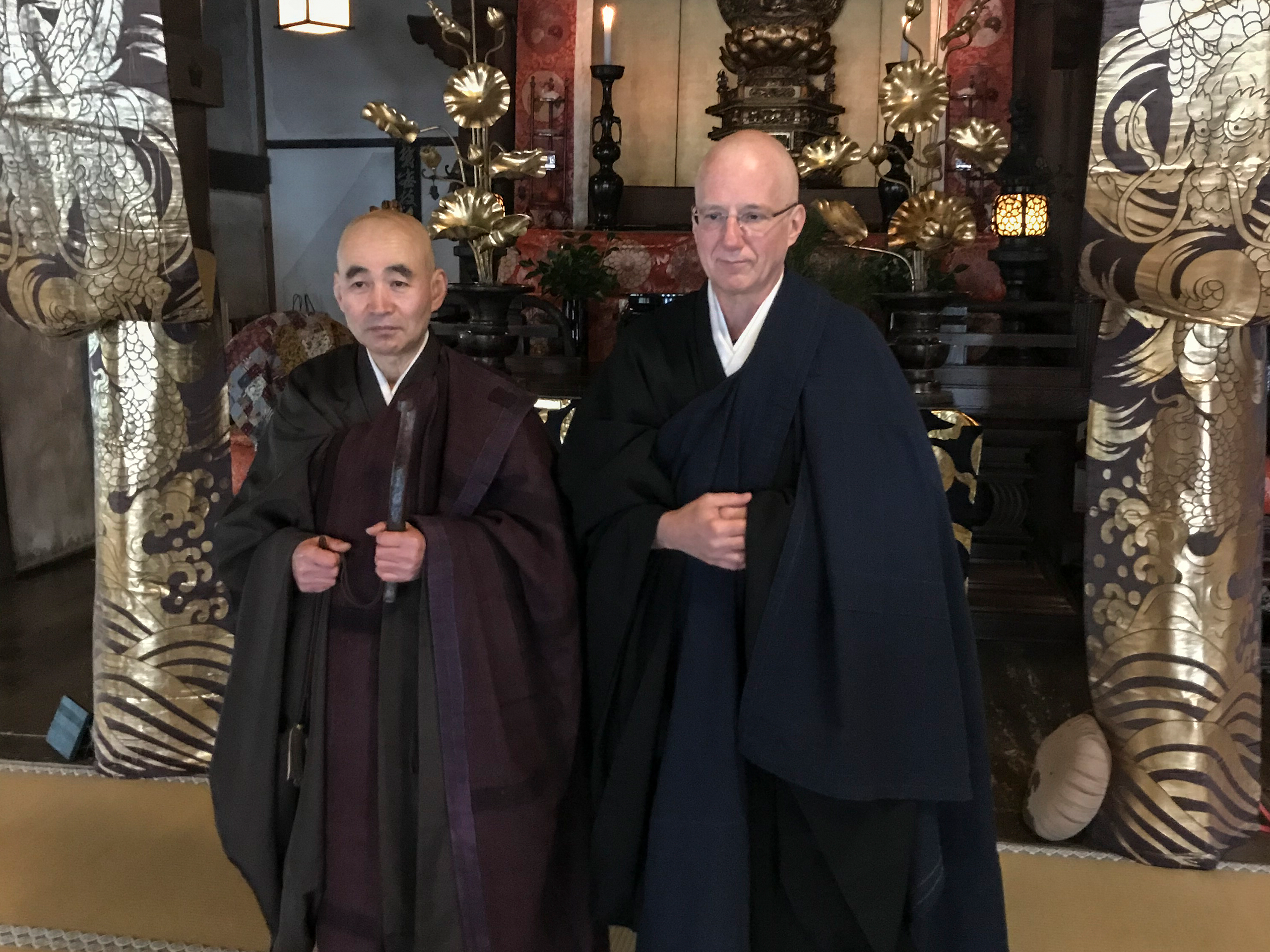 Bill Johnston (right) with his Buddhism teacher, Suzuki Seidō (left), Rōshi at Tōshōji in Okayama, Japan.
August was Make A Will Month. Bill Johnston, an AL amyloidosis patient, has pledged a legacy gift to the Amyloidosis Research Consortium (ARC). Here’s why.
Bill Johnston grew up in Rawlins, Wyoming. “The big city of Rawlins,” as he puts it, about 7,000 people, with the next town more than 100 miles away. “If I had stayed there and developed amyloidosis, would the doctors have even had any idea what was going on? There’s a chance they wouldn’t.”
He didn’t stay. Bill lives south of Middletown, Connecticut, roughly halfway between Boston and New Haven. He sees a specialist at Dana-Farber and another at Yale Smilow. That proximity to expert care, he believes, is a large part of why he is alive today.
“I have been extraordinarily lucky,” he says.
Most people with amyloidosis aren’t so lucky. Many are diagnosed only after months of missed signs, by a doctor who happened to recognize the pattern, if they’re diagnosed in time at all. That need is real today, and ARC is working on it now. But Bill was thinking about something else too: making sure the work never stops. He wanted to know that the specialist who catches it early, and the research that made his treatment possible, would still be there for the patients and doctors who come decades from now. That’s why ARC is in his will.
A Medical Mystery
Bill’s symptoms piled up for a while before anyone put them together. Carpal tunnel syndrome. Macroglossia. Edema. Shortness of breath. Peripheral neuropathy with stabbing pains in the fingers and toes, especially at night. His first cardiologist couldn’t fit the pieces together.
“He told me, ‘You’re a medical mystery. I have no idea what’s going on,’” Bill says.
The breakthrough came during a cardiac stress test, when a cardiologist watching his echocardiogram stopped on something. “I think I see amyloid,” she said. Bill had never heard of it.
His AL amyloidosis diagnosis was confirmed in December 2024. He started Dara-CyBorD, weekly for six months, then monthly after that with just daratumumab. The response was fast.
“All of the specialists, their jaws were dropping,” he says. “The Dara-CyBorD treatment for myself just did miracles.” A bone marrow transplant had been on the table. It came off, and at a recent visit, his specialist at Dana-Farber told him he could expect the same life expectancy as someone who never had the disease.
She also told him that if he hadn’t been diagnosed as early as he was, he might not be here.
Looking for the People Doing the Most
Once the disease had a name, Bill went looking for information and for the best places to learn about amyloidosis. He started with PubMed, a free database providing access to over 40 million citations and abstracts in medicine, nursing, dentistry, and life sciences primarily designed for physicians. “What kind of organizations are out there,” he remembers thinking, “both for physicians and patients?”
He found that the Amyloidosis Research Consortium came up for both groups. “ARC just seem to be doing more than anybody else,” he says, “for both patients and physicians, or other medical professionals.”
He worked through the website page by page, picking up as much as he could understand. He wanted to help, he just wasn’t sure how much of a difference one person could make. “What can I do,” he asked himself, “that might be effective along the way?”
Why a Legacy Gift
The answer, for Bill, came down to lasting impact. Not everyone can write a large check today, but almost anyone can leave a legacy, and it is often the most meaningful gift a person ever makes.
““For me, it’s about where can I put money that I think is going to do genuine good for people in as many ways as possible.”
— Bill Johnston
A legacy gift isn’t meant to solve today’s emergency. That’s the work of the research and care ARC delivers right now, funded by the people who give today. A legacy is what makes sure that work never runs out. It sustains ARC for years to come, so there’s never a year without a newly trained specialist, and never a year without the research that turns a death sentence into a treatable disease. ARC is building both sides of the diagnosis gap that nearly cost Bill his life: training new specialists through its clinical fellowship program so more patients can reach an expert, while helping as many clinicians as possible recognize amyloidosis sooner.
“ARC helps support both generalists who will have the knowledge that’s necessary for diagnosis, and then specialists who would be able to handle the treatment,” Bill says. “That was one of the things that pushed me toward a legacy donation.”
He’d made this kind of decision before. Zen Mountain Monastery, where Bill attends the meditation retreats that have helped him for years, is in his will, along with two or three other organizations he believes in. He is also an ordained Sōtō monk at Tōshōji in Okayama, Japan.
And the practical side was easier than he expected. He braced for paperwork. There wasn’t much. “I just said, I’m doing this, and my lawyers went through things, and they said, yeah, this is no problem.” Bill has asked that his gift support AL-specific work, or go wherever ARC needs it most.
Building the Generations to Come
Bill is doing well, and with any luck his gift is many years away. That’s exactly how a legacy is meant to work. When the day comes, it will help build the generation of clinicians who aren’t in training yet, to care for the patients who haven’t been diagnosed yet, in towns like Rawlins, Wyoming.
Asked what he’d say to someone still thinking about it, he didn’t hesitate. “By all means, and for all the right reasons, support ARC. If you have amyloidosis, or know somebody who’s had it, you should be familiar with the difficulties of diagnosis and treatment, especially depending on where you’re located.”
Leave Your Own Legacy
A commitment in your will, through a gift of stock, a donor advised fund (DAF), or an IRA, helps fund amyloidosis research, care, and patient support for decades to come. It’s a way to make a lasting difference, whatever you’re able to give.
Learn more at arci.org/legacy or email giving@arci.org.
Want to help meet the need today? You can support ARC’s current research and patient programs at arci.org/donate.
Need Support?
The mental toll of amyloidosis is heavy. If you or a loved one are struggling with the emotional impact of a diagnosis, please call us at +1 (617) 467-5170 or email support@arci.org.
- Categories